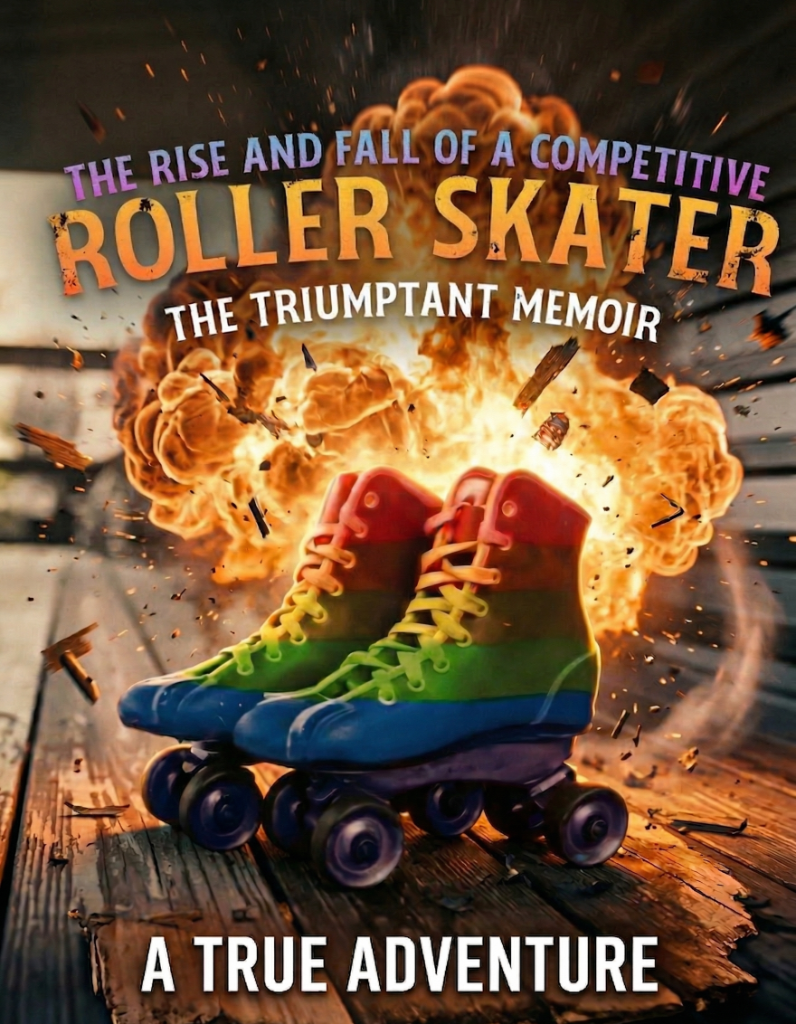
The Rise and Fall of a Competitive Roller Skater
The Full Memoir

The Rise and Fall of a Competitive Roller Skater

The Triumphant Memoir — by Victor Scott

16 chapters tracing the arc of a life shaped by sensitivity, bullying, skating, loss, and the long journey toward healing. Read below — in the order it was lived.

Chapter 1

Before I Knew the Word "Different"

I don't remember a time before I felt different. That feeling existed long before I had the language to describe it, long before I understood what made me stand apart. It wasn't dramatic or obvious, and it certainly wasn't something I chose. It was simply there, woven into my earliest memories like background noise you don't notice until it gets too loud to ignore.

As a child, I experienced the world intensely. Sounds felt sharper. Emotions lingered longer. I noticed shifts in tone, expressions, and moods that others seemed to miss. I didn't know that sensitivity could be a strength; I only knew that it made me feel exposed. I often felt as though I was slightly out of step with the rhythm of the world around me, trying to keep pace without understanding the rules of the dance.

Before kindergarten, there were already signs. I gravitated toward solitude more than group play. I preferred observation to participation, imagination to competition. I wasn't withdrawn so much as inward. I lived a great deal of my life in my head, where things felt safer, quieter, and more predictable.

Kindergarten changed that. That was the first place where I realized the world didn't just notice difference — it reacted to it. The classroom was loud, structured, and crowded, filled with expectations I didn't yet understand. I remember feeling overwhelmed by the noise, the movement, the constant demand to perform in ways that didn't come naturally to me.

What I didn't recognize then — but can name now — is that skating gave me permission to exist without apology. I wasn't trying to be acceptable or likable on the rink. I wasn't trying to disappear. I was simply present. That presence was rare in my life, and it was powerful.

Chapter one of my life wasn't about triumph. It was about survival, discovery, and the first fragile sense that I might not be broken after all — just wired differently. Skating didn't fix me. It revealed me.

Chapter 2

Learning How to Survive a Room

Bullying didn't arrive in my life as a single event. It wasn't one fight, one insult, or one moment I could point to and say, that's when it started. It was gradual, cumulative, and quiet at first — so quiet that I didn't immediately recognize it for what it was. It unfolded over time, slipping into my daily life until it felt normal, until I stopped expecting anything different.

In the early years, it often disguised itself as teasing. A joke made at my expense. A comment followed by laughter that felt sharp instead of playful. I remember moments when everyone else seemed amused, and I was left wondering why my stomach tightened, why my chest felt heavy, why I suddenly wanted to disappear.

As I got older, the patterns became clearer. Certain kids learned that they could get a reaction from me. Others learned that they didn't even need to say anything — looks were enough. Whispers traveled faster than words. A glance exchanged across a room could communicate exclusion just as effectively as an insult. The message was consistent: You are not like us.

Over time, bullying stopped being something that happened to me and became something I anticipated. I walked into classrooms already scanning the room, assessing where it was safest to sit, who to avoid making eye contact with, when to keep my mouth shut.

Bullying didn't break me, but it bent me. It trained me to move carefully through the world, to anticipate danger, to prioritize safety over expression. And while I couldn't see it then, that constant pressure — the feeling of being watched, judged, and cornered — was quietly preparing me for something else entirely. It was teaching me how to endure repetition, how to tolerate discomfort, how to stay present under strain.

Chapter 3

Love, Protection, and the Absence of Space

Home was not a place of cruelty for me. It was not loud with anger or chaos. In many ways, it was safe, predictable, and anchored by my mother's presence. She was loving, loyal, and deeply devoted. Her world revolved around making sure I was cared for, protected, and provided for. There was never any doubt that I was loved.

But love, like anything else, can become complicated when it isn't balanced. My mother held on tightly. At the time, I didn't question it. I didn't know there was another way to be loved. Her protectiveness felt natural, even necessary, especially given how the outside world treated me.

What I didn't yet understand was that protection and independence aren't opposites — they're partners. And without independence, protection can quietly become confinement. Decisions were often made for me rather than with me.

This created a strange dynamic. On one hand, home was the place where I felt safest. On the other, it was a place where I felt responsible — not just for myself, but for her emotional well-being too.

Continue Reading

Purchase the full memoir to unlock all 16 chapters of Victor Scott's triumphant story.

Buy on Barnes & Noble

Chapters 1 & 2 are free to read

"Bullying didn't break me, but it bent me. It trained me to move carefully through the world, to anticipate danger, to prioritize safety over expression."

— Chapter 2 — Learning How to Survive a Room

Chapter 4

Leaving School, Finding Motion

By the time I reached high school, I was already tired in a way that had nothing to do with sleep. Years of bullying, self-monitoring, and emotional pressure had stacked up quietly, layer by layer. I had learned how to endure situations, how to keep my head down, how to survive day by day — but I had never learned how to recover from what I was carrying.

High school wasn't a sudden breaking point. It was more like a slow erosion. Each year took a little more out of me than the one before it. I felt watched even when no one was paying attention. I questioned myself constantly.

In December of my senior year, I dropped out. It wasn't a rebellious decision or a moment of defiance. There was no slammed door or grand announcement. It felt quieter than that — like slipping out a side exit after realizing I couldn't stay inside any longer.

Skating, however, remained constant. While school felt chaotic and unpredictable, the rink was structured and familiar. The floor didn't judge me. The music didn't care where I came from or what I'd failed at. When I skated, my body took over in a way my mind never could. Movement gave me clarity when words failed me.

Continue Reading

Purchase the full memoir to unlock all 16 chapters of Victor Scott's triumphant story.

Buy on Barnes & Noble

Chapters 1 & 2 are free to read

Chapter 10

After the Structure Disappears

At first, I tried to recreate the structure I had lost. I told myself that discipline was discipline — that if I applied the same intensity I had given skating to the rest of my life, everything would fall back into place. I made lists. I set goals. I mapped out imaginary timelines for success. But without a true center, all that effort felt hollow. I was moving, but I wasn't grounded.

I had spent so many years being told where to be and when, what to practice and how to improve, that when those external markers disappeared, I realized how little I trusted my own internal compass. Skating had always answered the question: What now? Without it, that question echoed endlessly.

I flirted with possibilities — ideas about performance, entertainment, maybe even education. I talked about them with confidence, as if saying them out loud would make them solid. But inside, I felt fragile. Every option carried pressure.

Looking back now, I can see that this was the early stirring of something much bigger. At the time, I just thought I was adjusting.

Continue Reading

Purchase the full memoir to unlock all 16 chapters of Victor Scott's triumphant story.

Buy on Barnes & Noble

Chapters 1 & 2 are free to read

"I used to think healing meant becoming someone else. Stronger. Tougher. Unaffected. What I've learned instead is that healing is becoming more yourself, not less."

— Chapter 16 — The Other Side

Chapter 13

The Weight of Carrying Everything Alone

By the time I reached this part of my life, I had already learned something that most people don't realize until much later — if they ever do. Survival doesn't always look dramatic. Sometimes it looks quiet. Sometimes it looks like staying still when everything in you wants to run. Sometimes it looks like getting up, day after day, without applause, without witnesses, without certainty that it will ever get easier.

I had already lived several lives inside one body by then. Each version of me carried scars the next one didn't ask for. Childhood taught me how to endure. Skating taught me how to focus. Loss taught me how to disappear.

There's a difference between being strong and being hardened. I had crossed that line without noticing. I wasn't just protecting myself anymore; I was sealing myself off. Trust had become conditional. Vulnerability felt dangerous.

This chapter of my life wasn't defined by one dramatic event. It was defined by accumulation. By the slow realization that unresolved experiences don't disappear just because time passes. They wait. They settle. They resurface when the structure holding them finally weakens.

Continue Reading

Purchase the full memoir to unlock all 16 chapters of Victor Scott's triumphant story.

Buy on Barnes & Noble

Chapters 1 & 2 are free to read

Chapter 14

Unlearning

By the time I reached this part of my life, I had already learned that survival and living were not the same thing. Survival had become almost automatic, something my body knew how to do without asking my permission. Living, though, was different. Living required choice. It required presence.

What no one prepared me for was how little control I would feel when the structure disappeared. When competition ended, when injury intervened, when the identity I'd wrapped around skating began to loosen, I felt unanchored. I wasn't just grieving the loss of a sport — I was grieving the loss of certainty.

This chapter of my life wasn't about learning something new. It was about unlearning. Unlearning the idea that worth must be proven. Unlearning the belief that rest equals weakness. Unlearning the reflex to measure myself against other people's timelines.

What I didn't realize at the time was that this wasn't regression. It was integration. I wasn't being dragged backward — I was learning how to carry the past without being crushed by it.

Continue Reading

Purchase the full memoir to unlock all 16 chapters of Victor Scott's triumphant story.

Buy on Barnes & Noble

Chapters 1 & 2 are free to read

Chapter 16

The Other Side

There's a strange stillness that comes right before something truly ends — not the kind that feels empty, but the kind that feels settled. I didn't rush into this final chapter. I arrived here slowly, deliberately, carrying less with me than I ever have before. That alone tells me everything I need to know about how much has changed.

For most of my life, I believed endings meant loss. I treated every ending like a failure, even when it was necessary. Especially when it was necessary. I clung to people, places, patterns, and identities long after they stopped serving me.

What I know now is that I wasn't weak — I was afraid. Afraid that if I stopped moving, stopped fighting, stopped holding on, everything would collapse. Afraid that without struggle, I wouldn't know who I was.

This chapter exists because that fear no longer runs the show.

Continue Reading

Purchase the full memoir to unlock all 16 chapters of Victor Scott's triumphant story.

Buy on Barnes & Noble

Chapters 1 & 2 are free to read

"I'm not looking back to see if something is chasing me. I'm looking ahead — steady, grounded, and finally at peace with where I stand."

— Victor Scott, Chapter 15

The Memoir

A story of ambition, heartbreak, and the relentless pursuit of greatness on eight wheels.

Connect

For speaking engagements, press inquiries, or just to share your own story — reach out.

Email Victor

© 2026 The Rise & Fall of a Competitive Roller Skater. All rights reserved.

base44
Edit with Base44